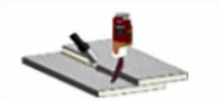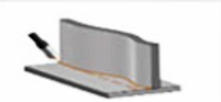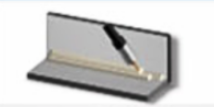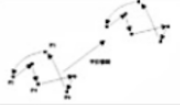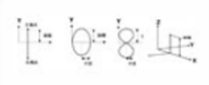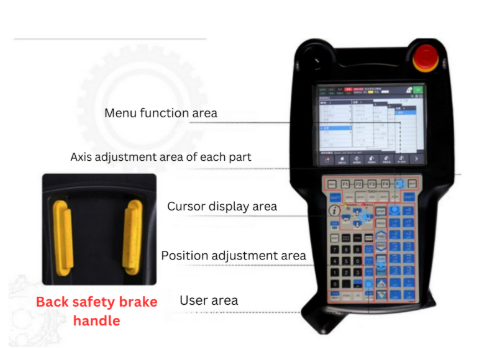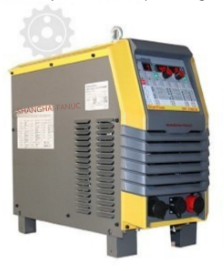
| Starting point search | Laser positioning | Arc tracking | Multi-layer and multi-channel | Program offset |
|---|---|---|---|---|
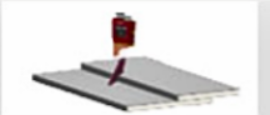 Touch Sensing is a software feature used by ANUC robots to detect the workpiece prior to welding. For arc welding, the robot uses a pre-programmed procedure (e.g., holding wires, conductive nozzle) to set contact with the outer perimeter of the workpiece’s actual position or the offset between its actual position and the taught position. This offset is then compensated for during subsequent welding. |
The joint laser replaces the welding wire, the positioning actual weld position, so that the robot can adjust the weld position and find the positioning accuracy is 0.5MM (Through-Arc Seam Tracking, restricted to more more. When the robot welding trajectory changes greatly, no matter what to touch the workpiece with contact, the work conditions of the workpiece is, and will not affect the success rate of positioning. When ANUC robots have high positioning accuracy and strong adaptability) |
The Through-Arc Seam Tracking (FAST) function is an intelligent arc welding software function specifically developed by ANUC for robot arc welding applications. It is used to compensate for the deviation between the taught welding trajectory and actual welding trajectory) is always consistent with the actual weld position. |
The Root Pass Memorization and Multi pass functions are intelligent arc welding software functions specifically developed by ANUC for robotic arc welding applications. They utilize position offsets on the basis of root pass offsets, and for multi-pass welding, the following two functions allow for program transfer operations, the facilitates teaching programming for thick plate welding. |
Transfer function: transfer the teaching position to another position in parallel or in parallel rotation. Two types of offset method: one teaching position to another position in a plane symmetrical manner. Angle input: X, Y and Z with the angle of the three coordinate points and rotation angle. Coordinate system conversion and transfer: by changing the tool coordinate system and the user coordinate system, the position data is transformed so that the TCP’s in the same position. |
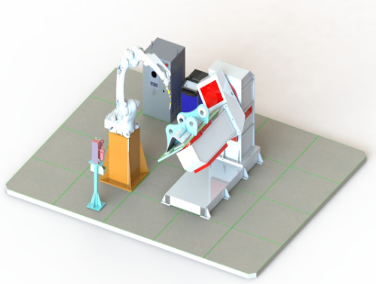
| Yaw function | Welding tilt | Heat wave function | TCP fixed quickly | Offline programming |
A variety of standard oscillation types are available: (e.g., circle, figure 8, and U-shaped oscillation) configures the oscillation and operating angle can be adjusted as needed; users can customize the oscillation type according to the work form. | 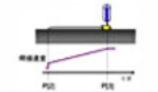 The user can gradually increase or decrease during transit welding, welding conditions such as welding voltage and welding within a specified interval (time positions) to achieve the purpose of changing without change smoothly. Welding conditions change gradually from the start of the arc to the end of the arc so that during welding conditions, the welding speed, oscillation frequency and amplitude can also be fitted). | 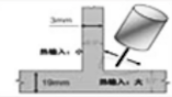 Such as voltage and current are controlled based on the torch’s position. Different welding parameters can be set along the center, left, and right endpoints of the travel speed. This function is particularly suitable for welding workpieces of varying thicknesses. |  The robot and welding gun can quickly detect the collision and stop the robot when it collides to protect the robot. The robot will stop after a collision detection function can effectively ensure that the robot welding gun will not be severely damaged in the event of an accidental collision. No need for external anti-collision devices, and it is fully realized only through software. Welding gun TCP fast recovery function and automatic fast repair of welding gun TCP. |  Automatically generate offline trajectory program. Teaching programming of complex workpieces is difficult. Refuse on-site |