
3-D printing for fashion

3D printing Knowledge of fashion elements

3D printing has been around for a while, and people are no strangers to it. 3D printing was first used in the industrial field, and then 3D printing technology was promoted and applied to the field of headwear, bringing new technology to the industry.

3D printing is actually not complicated. Several issues of 3D printing have been introduced in detail. The essence of 3D printing is to use digital model files in a computer, add suitable materials such as metal and plastic, and then print layer by layer, to build the target product, and that’s 3D printing.

3D printing has a wide range of fashion elements

The application of 3D printing technology can improve the working efficiency of workers. 3D printing technology uses direct layer-by-layer printing technology to print products with high speed, high quality and high efficiency. In the field of headwear, traditional headwear production relies on manual labor:

Through the human work to achieve cutting, embroidery, carving and other processes, the difference in raw materials make product quality, can not be unified, because the technical proficiency of different people also make product quality.

The appearance of 3D printing technology has a great impact on the traditional industry. In the 3D printing of headwear, only the drawing of the target product in the computer can be carried out, thus greatly improving the accuracy of the product.

The emergence of 3D printing technology will promote the development of high-level headwear customization. With the help of 3D printing technology, designers can collect the user’s wearing data, and produce the product according to the user’s actual situation. Through the use of the data, the product and the user’s head can fit together more, in accordance with the user’s preferences on the basis can reduce the waste of raw materials, reduce production costs.

In the making of traditional headwear, the actual effect of the product can be seen only after the product is produced. In contrast, 3D printing, in which a producer can model a product to see its visual effects in advance, can also be used in design to improve the selection of materials through visual effects. This is the new technology on the traditional headwear industry production model of the fundamental subversion.

The application of 3D printing technology in headwear can maximize the uniqueness of headwear and make the design of headwear very personalized. At present, consumers more and more in pursuit of individual, personalized products, the design of headwear has become more diverse, more in line with consumer preferences.
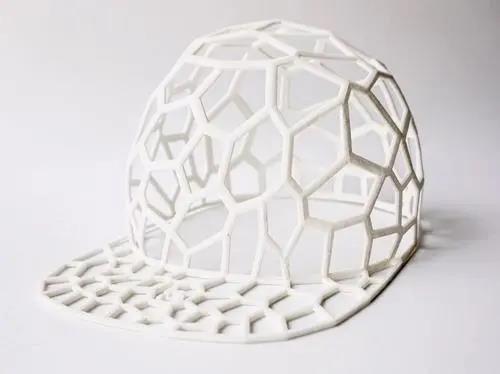
In the field of headwear, headwear is no longer ordinary jewelry. Headwear already carries elements such as luxury and concept, among which headwear can reveal one’s taste, value concept, etc., as a result, many consumers are more careful when choosing headwear, but also to the creation of personalized headwear provides a huge market.

It is a new trend for designers to design headwear according to the needs of the users. The product-driven design is changed to the consumer-driven design. Designers produce products according to the needs of the users, 3D printing has incomparable advantages.

Through the 3D printing technology, 3D modeling perspective, designers can directly see the visual effects of products, which is traditional headwear production technology, can not be compared.

After designing the 3D model, the designer can adjust the material of the product, making the material more suitable, making the material more accurate, and reducing unnecessary waste.

In addition, in 3D printing, it is easier for the designer to make adjustments. The effect of the product can be seen through 3D models and renderings. If it is different from the customer’s expectation, the designer can make adjustments, it also reduces the waste of resources.

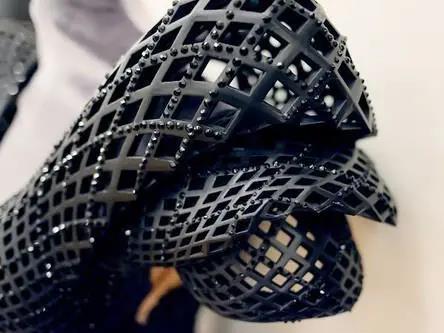
At the 2013 Victoria’s Secret show, a pair of angel wings symbolizing top model status were 3D printed, created by Swarovski and Shapeways, a master of 3D printing, as an example of how 3D printing can be applied to clothing, the appearance of this dress amazed the world, I believe that 3D printing in the future, will be able to do a lot.

At present, 3D printing technology is not in large-scale use, analysis of the reasons can see that the use of printed materials has greatly limited the promotion of 3D printing application.

The specific application of 3D printing in headwear is the casting and polishing of traditional headwear after 3D model building. Currently, 3D printing materials are limited to waxes, plastics, metals, and so on, but the use of metal materials will make the cost of production greatly increased, this is not realistic.
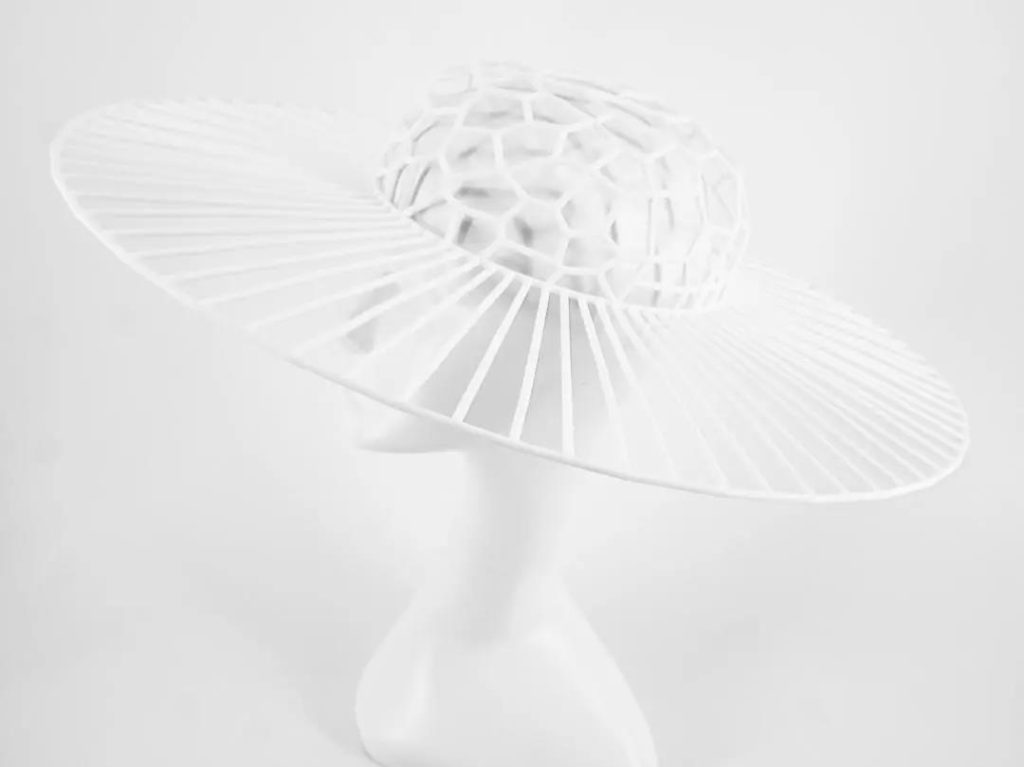
In addition, there are obstacles in the development and supply of 3D printing materials. The technical requirements are very high, so today 3D printing still does not form an industry chain. This reality makes the standards of materials not uniform, it has greatly limited the application of 3D printing in headwear industry.

In addition, in the actual production of the headwear industry, many people who are engaged in 3D printing do not have the ability to draw, and their artistic level is not high, while designers are only responsible for drawing, and can not use 3D printers, two interdisciplinary talents are rare, and that’s the dilemma.
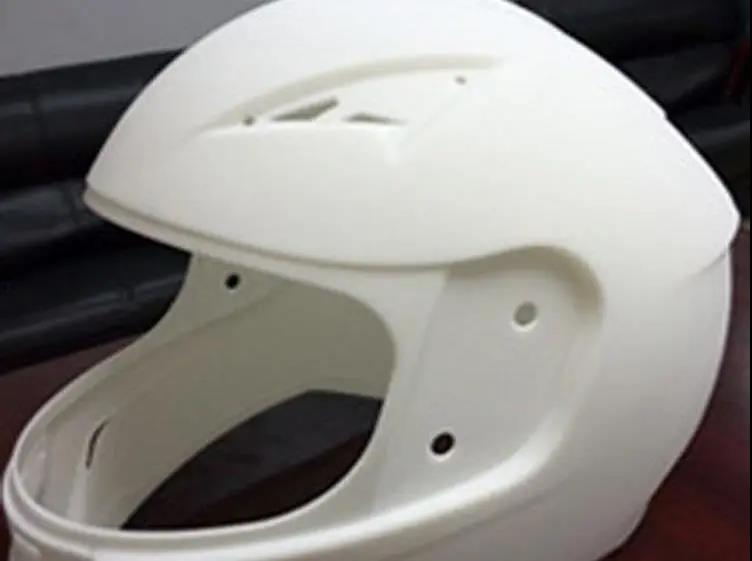
This artificial separation of drawing and 3D printing is not conducive to the production of the product. The production of the product depends on the production of the process, but the soul of the product is given by the designer.

In today’s era of high-speed development of science and technology, new processes are used in traditional industries to make the development of the industry more dynamic. The emergence of 3D printing gives more possibilities to the design of headwear, but the soul of the product is given by the design, and the new process provides more possibilities for the product. Right now, we need to think seriously about how to use modern technology and use our creativity to create products that consumers love.
Comments Box SVG iconsUsed for the like, share, comment, and reaction icons
Cover for JTC Laser
JTC Laser

JTC Laser

935,180 Likes

Intelligent robot workstations, intelligent work islands, providing the entire process (cutting, assembly, welding, grinding, inspection, etc.) of intelligent applications for the non-standard metal structure manufacturing industry.

Sell and deploy them, one application scenario after another!
lasermanufacture.com/robotic-welding-system-selection-guide/
See MoreSee Less

6 days ago

It integrates the wire drum, welding power source, robot controller, and electrical cabinet, all mounted on the rail.

Installation is simple. Secure the expansion bolts on both sides, connect the cables to the standard ports, and then connect the power supply, wire-feed system, shielding-gas line, and compressed-air line. Start the computer, and the system is ready to operate.

Now, let’s see how it welds custom components. Use a forklift to position the workpiece freely beneath the robot. Large components can also be loaded with an overhead crane. No dedicated fixture is required.

Once the component is in place, the operator opens the system and moves the robot along the X-axis rail until it is positioned above the area to be welded.

A vision system is mounted on the robot. The operator clicks the capture button in the software interface, and the system acquires the component’s point-cloud data. The operator then defines the weld lines on the point cloud and assigns the welding task.

After the operator clicks “Confirm,” the robot scans the actual weld seams and collects detailed point-cloud data. Once the scan is complete, the system automatically calculates the welding path and generates the welding program.

The operator simply clicks “Confirm” again to begin welding. The entire process requires only a few mouse clicks.

While one robot is welding, the operator does not need to wait at the control station. Instead, the operator can prepare or operate a second or third robot, improving overall production efficiency.

Straight seams, curved seams, and wrapped corner welds can all be generated in a single programming cycle.

When the workpiece changes, the system can recognize the new component and generate the corresponding welding program.uses standardized equipment to handle a wide range of non-standard components.

The system can process components up to 3.5 meters wide and approximately 600 millimeters high. It can weld one type of component today and switch to a completely different component tomorrow.

Like and save this video. In the next video, we’ll introduce the nine-axis cantilever welding workstation.
See MoreSee Less

1 week ago

New features for existing customers—delivered through OTA updates.

We are upgrading our customers’ systems to the latest version, making robotic welding easier, faster, and more efficient to operate.

Robotic welding of ship outfitting components is now in progress…

Continuous upgrades. Simpler operation. More value from welding automation.

#RoboticWelding #SmartWelding #OTAUpdate #shippingbuilding #ShipOutfitting #WeldingAutomation #jtclaser

lasermanufacture.com/what-determines-robotic-welding-quality-a-practical-guide-to-vision-control-…
See MoreSee Less

1 week ago

A veteran welder with 11 years of experience recently asked me three questions. Out of respect, I would like to offer a brief response.

1. Is the Industry Led by Technology or Capital?

To determine whether an industry is driven by technology or capital, we should first consider two questions: What does the industry truly lack—technology or funding?

If a technology genuinely offers a competitive advantage and clear commercial value, it is unlikely to remain underfunded for long. However, even if a company has sufficient capital, that does not necessarily mean it can acquire or develop truly core technologies.

Capital helps technology move from research and development into industrialization and large-scale commercial application. It allows technological achievements to spread more quickly and enables more manufacturers to benefit from technological progress.

However, capital must be supported by genuine technological capability and real product value. Without a solid technical foundation, financial investment alone cannot create sustainable competitiveness.

This is particularly important in the robotic welding industry. A company may be able to advertise a welding robot for sale, but the long-term value of that system still depends on its underlying technology, welding capability, reliability, and real production performance.

Therefore, technology is the foundation, while capital is a tool that accelerates commercialization and market adoption. Capital may appear to be driving the industry, but core technology ultimately determines its direction.

2. The Two Technical Paths Behind Programming-Free Welding

Some companies in the robotic automation industry have been operating for ten or even twenty years, yet they still rely heavily on traditional technical approaches and rarely attempt to build an entirely new intelligent welding system.

To some extent, this comes from an excessive dependence on past experience. Experience is undoubtedly valuable, but it can also restrict a company’s ability to explore new technical paths.

If our understanding of automation and intelligent manufacturing does not undergo a fundamental transformation, then even after ten, fifteen, or twenty years in the industry, we may still remain within the traditional framework.

We have been continuously developing scan-and-weld and programming-free welding technologies for seven or eight years. Today, an increasing number of companies are entering this field, and more buyers are beginning to compare a conventional robotic welder for sale with a genuinely intelligent, programming-free welding system.

Before these technologies emerged, welding mainly depended on two approaches: traditional automation and skilled human welders.

Intelligent manufacturing can essentially be understood as the further development of these two paths.

The first path is the upgrade of traditional automation.

A three-dimensional model is imported first, followed by programming and trajectory planning. A vision system is then used for workpiece positioning, weld seam detection, and deviation correction before welding begins.

This is essentially an advanced version of conventional robotic automation. It improves accuracy and adaptability, but the basic operating logic still depends on models, programming, and predefined trajectories.

The second path is the intelligent upgrade of the way an experienced welder works. This is what we call “scan-and-weld.”

After receiving a drawing and observing the workpiece, an experienced welder can quickly determine the weld position, welding sequence, and torch angle before starting the welding process. This can be described as “see-and-weld.”

If we replace the welder’s eyes with machine vision and convert the welder’s experience into algorithms, welding process databases, and intelligent decision-making systems, the robot can scan and identify the workpiece and then automatically generate the welding task.

This is what we mean by “scan-and-weld.”

It is not simply a matter of adding a vision system to a robot. The real objective is to give the robot recognition, judgment, planning, and execution capabilities similar to those of an experienced welder.

When customers evaluate different systems, they should therefore look beyond the basic machine configuration. Two systems may appear similar, but their actual intelligence, ease of use, welding process capability, and adaptability can be completely different.

I do not intend to explain the deeper technical principles in excessive detail here. Once this technology is widely adopted, its actual market performance will provide the clearest answer.

3. Why Are Intelligent Manufacturing Systems Still Relatively Expensive?

This question is not difficult to understand.

At present, intelligent manufacturing is still in a stage of continuous investment, technological development, and market validation. Industry pioneers must bear substantial research and development costs, testing expenses, talent costs, and market education expenses.

This is also why searches such as welding robot price or robotic welding machine price cannot be answered accurately with a single standard figure.

The final cost of a robotic welding system depends on many factors, including robot configuration, working range, external axes, vision technology, welding process requirements, software capability, safety systems, installation, training, and after-sales support.

A low initial quotation does not necessarily mean a lower total cost of ownership. If a system requires extensive manual programming, frequent technical intervention, or complicated fixture preparation, the customer may face much higher operating costs later.

Followers in the industry also face their own challenges.

Once a technical path has been proven, a large number of companies may quickly enter the market and imitate it. As competition intensifies, product prices and profit margins inevitably decline.

Innovators bear the risks and costs of early-stage research and development, while followers face intense price competition later. This is a common pattern in the development of emerging industries.

Therefore, when customers search for an industrial welding robot for sale, they should not evaluate the system based only on its purchase price. They should also consider productivity, programming time, labor requirements, welding quality, system stability, maintenance support, and long-term operating costs.

Whether a company is a technology pioneer or a later market entrant, the ultimate objective should be the same: to use intelligent manufacturing to reduce production costs, improve product quality and production efficiency, and reduce excessive dependence on manual labor.

We hope that the manufacturing industry of the future will become more competitive. At the same time, we hope frontline workers can gradually move away from repetitive, dangerous, and harsh working environments and transition into positions with greater technical value, better working conditions, and higher incomes.

That is the fundamental purpose behind our commitment to intelligent manufacturing.
See MoreSee Less

1 week ago
Load more

Latest News

Contact Details

Subscribe Us

Join our newsletter; you will receive our newest videos/tips of our laser marking, cutting, welding, cleaning and cladding machine’s latest prices and the latest promotional news


You will also get our monthly report of best products, and also coupons.

Inquire Now

Feel free to inquire now. We are always here to help you.

¡Consulta ahora!

Siéntase libre de hacer su consulta ahora. Siempre estamos aquí para ayudarlo.

استفسر الآن

لا تتردد في الاستفسار الآن. نحن دائمًا هنا لمساعدتك.

Связаться сейчас

Не стесняйтесь задавать вопросы. Мы всегда готовы помочь вам.