1- GENERAL REMARKS
1-1 Power Source Features
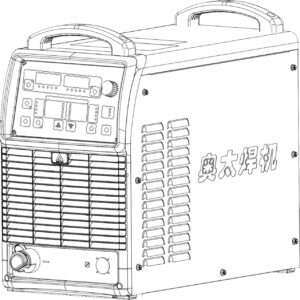
This series of power sources apply 60kHz IGBT soft switch inverter technology. Its internal control system uses DSP, ensuring quick response during the welding process for precise control and optimal results. The strong arc self-adjustment ability provides a highly stable welding current against grid fluctuation and arc length changes.
This series includes a 3-core system and is compatible with almost all robots on the market via digital or analogue interfaces, making robotic welding integration easy.
Highlights:
- 60kHz inverter frequency for real-time droplet energy management, concentrated arc energy, and high stiffness.
- Advanced energy control allows stable pulse welding with cable lengths up to 45m, even with low current.
- Wide compatibility with mixed gas types and consistent electrode extension to current ratio.
- Flexible arc-starting modes with high success rate.
- Platformized design with support for multiple advanced welding modules including pulse, double pulse, low spatter, and more.
- Strong oxidation film cleaning, excellent arc control, and beautiful welds in aluminum alloy welding.
- Push-pull torch support with standard circuitry, enabling TIG-level quality in aluminum welding.
- Dual 32-bit ARM processors with nanosecond response times in the control system.
- Advanced twin closed-loop wire feeding with high-torque permanent magnet motor for accuracy and stability.
- Memory for storing and recalling up to 100 parameter sets.
- IC card binding for authorized use, quality control, and traceability.
- Supports multiple digital communication protocols (e.g., FANUC, ABB, KUKA, YASKAWA, COMAU).
1-2 Functional Principle
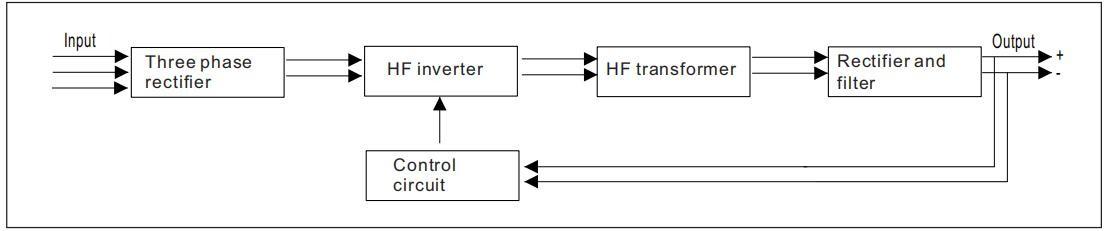
This series uses 60kHz IGBT inverter technology for enhanced dynamic response and compact, lightweight construction. A closed-loop control circuit ensures resistance to power fluctuation and excellent welding performance.
Fig. 1-2-1 – Schematic Diagram:
1-3 Output Characteristics
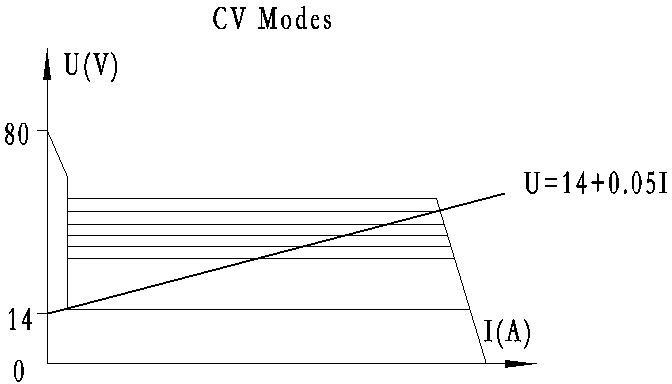
Fig. 1-3-1 – Output Characteristics:
1-4 Duty Cycle
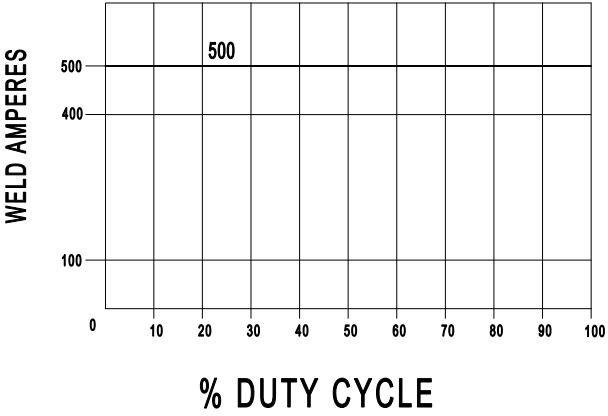
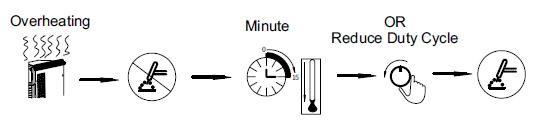
Duty cycle refers to the percentage of a 10-minute period that a machine can weld at rated load without overheating. If overheating occurs, the thermostat shuts down output. Wait at least 15 minutes before restarting. Reduce the amperage or duty cycle to prevent overheating.
Note: Exceeding the duty cycle can cause permanent damage and reduce machine lifespan.
Fig. 1-4-1 – Duty Cycle:

1-5 Applications
This series supports a variety of welding processes and is suitable for most metal materials including carbon steel, stainless steel, aluminum, Al-Mg alloy, and copper.
Recommended Application Areas:
- Automated applications
- Robot welding systems
- Automobile and component supply industry
- Vehicle manufacturing
- Machinery manufacturing
- General industrial use
1-6 Warning Label
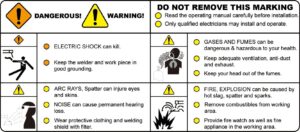
The warning label is affixed on the top of the machine.
Fig. 1-6-1 – Warning Label: